Major Arcana · 13 · Water
Death
Something is finishing. Let it, and make room for what comes next.
How it feelsSolemn, tender, relieved.
What it asks of youHonor what is ending, then turn toward the next chapter.
Upright
- endings
- change
- letting go
- clearing space
- new chapter
Reversed
- holding on
- resisting change
- limbo
- stagnation
- unfinished goodbyes
The picture
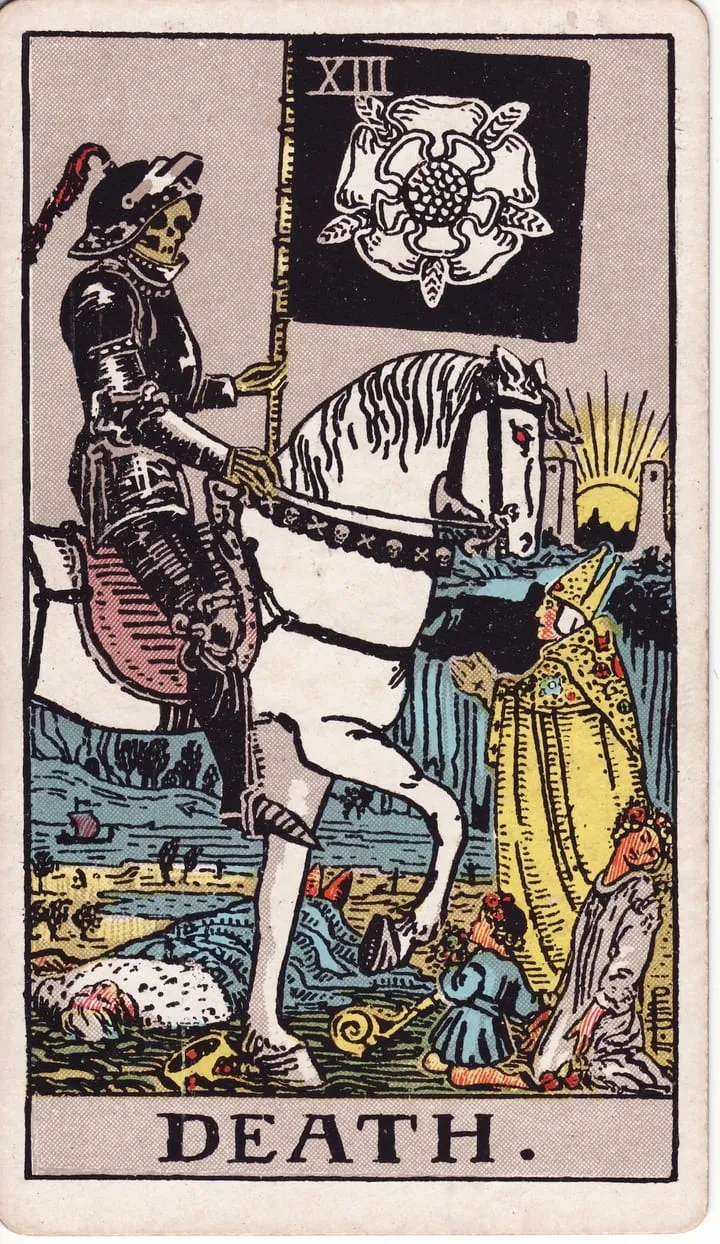
A skeleton in black armor rides a white horse, carrying a black banner marked with a large white rose. Before the horse, a king has fallen and his crown lies on the ground. A bishop in yellow robes stands with his hands pressed together, and a child and a young woman kneel nearby. Behind them a river flows past with a small boat, and on the far horizon the sun shines between two towers.
Waite calls the card a picture of “change, transformation and passage from lower to higher.”
Meaning
Death is the card of endings that clear the way for change. Very rarely is it literal. It points to a chapter closing: a role, a relationship pattern, a habit, a way of seeing yourself. Something has run its course, and the card asks you to let it go so that something new has room to grow.
Upright, it suggests a real transition. Endings can bring sadness, and the card does not ask you to skip that. It also carries relief, honesty and a fresh start. Think of autumn leaves: they fall so the tree can live through winter and grow again. Waite writes, “The mysterious horseman moves slowly.” This kind of change tends to be steady and natural, not a sudden shock.
Reversed
Reversed, the ending is being held back. You may be clinging to something that is already over, or stuck in between: the old way no longer works, and the new one has not begun. Waite’s reversed meaning speaks of inertia and lethargy. Gently ask what you are afraid to release. Sometimes the change is already happening inside, even if little has moved on the outside.
Symbols
White rose
The black banner carries a white rose. Waite calls it “the Mystic Rose, which signifies life.” Even at the heart of an ending, the card’s emblem is a flower: life continuing in a new form.
Armored rider
The rider wears armor but holds no weapon. Waite points out that he carries no weapon at all. Change does not need force. It arrives in its own time, and nothing can stop it.
White horse
The rider sits on a white horse moving at a steady walk. White is commonly read as purity: change that clears the ground for something new.
Sun between towers
On the horizon the sun shines between two towers. Waite calls it “the sun of immortality”. Many readers see a sunrise: after the ending, a new day.
The bishop
The bishop faces the rider with his hands together. Some read acceptance, some bargaining. Either way, the change goes on.
King, child and maiden
A king, a child and a young woman all meet the rider. Change comes to everyone, whatever their rank or age.
River and boat
The river keeps flowing. A boat sails on.
In context
- General: something is ending. Let it, and make room for what is next.
- Love: a relationship changes form, or an old pattern ends. Honest closure helps both people.
- Career: a role, project or job comes to its natural close. Prepare for the next phase instead of holding on.
- Money: a time to close old accounts, habits or plans that no longer fit.
- Self: which version of you are you ready to outgrow?
Light and shadow
- Light: acceptance, release, renewal, honest endings.
- Shadow: clinging, denial, closing doors too abruptly.
Common misreading
Taking the card literally. In tarot, Death is a symbol of transformation: a season changing, a door closing as another opens. Its banner carries a rose, and its horizon a sun. Read it as an invitation to let go, not as a warning.