Pentacles · Eight · Earth
Eight of Pentacles
Head down at the bench, getting better one piece at a time.
How it feelsAbsorbed, patient, content with the work.
What it asks of youMastery is built by hand, one careful piece after another.
Upright
- craftsmanship
- apprenticeship
- focus
- quality
- steady improvement
Reversed
- perfectionism
- burnout
- rushed work
- going through the motions
- talent put to poor use
The picture
A young man in a blue tunic, dark apron and red hose sits on a wooden bench. He holds a hammer in one hand and a chisel in the other, cutting a star into a coin that rests on a block in front of him. Five finished coins hang one above the other on a tall post to the right, a sixth stands at its foot, and a last one lies on the ground below the bench. Far off on the left stands a small town.
Waite describes “An artist in stone at his work, which he exhibits in the form of trophies.”
Meaning
The Eight of Pentacles is the card of practice. The Ace held out a single coin; here someone is learning to make them. The coins on the post share one design, each made by hand: the same task, done again, a little better each time.
Upright, the card points to work that asks for attention and patience. You may be learning a trade, studying, starting a new role or refining something you already know well. Waite names “skill in craft and business, perhaps in the preparatory stage”: before the reward, while the habit is forming. It also speaks of quiet pride. The worker is not looking for an audience, and the satisfaction comes from the work itself.
There is a gentle warning too. The town is far away, and he does not look up. Deep focus is a gift, as long as it does not shut out the rest of life.
Reversed
Reversed, something has gone wrong in the workshop. The craftsman may polish the same coin forever, or work such long hours that the rest of life thins out. Or the opposite: the hammer moves but the heart has left, and the work gets hurried and careless. Waite’s reversed meanings begin with “Voided ambition, vanity”, and he warns of skill turned to cunning. Ask what the work is for, and whether it still feels like yours.
Symbols
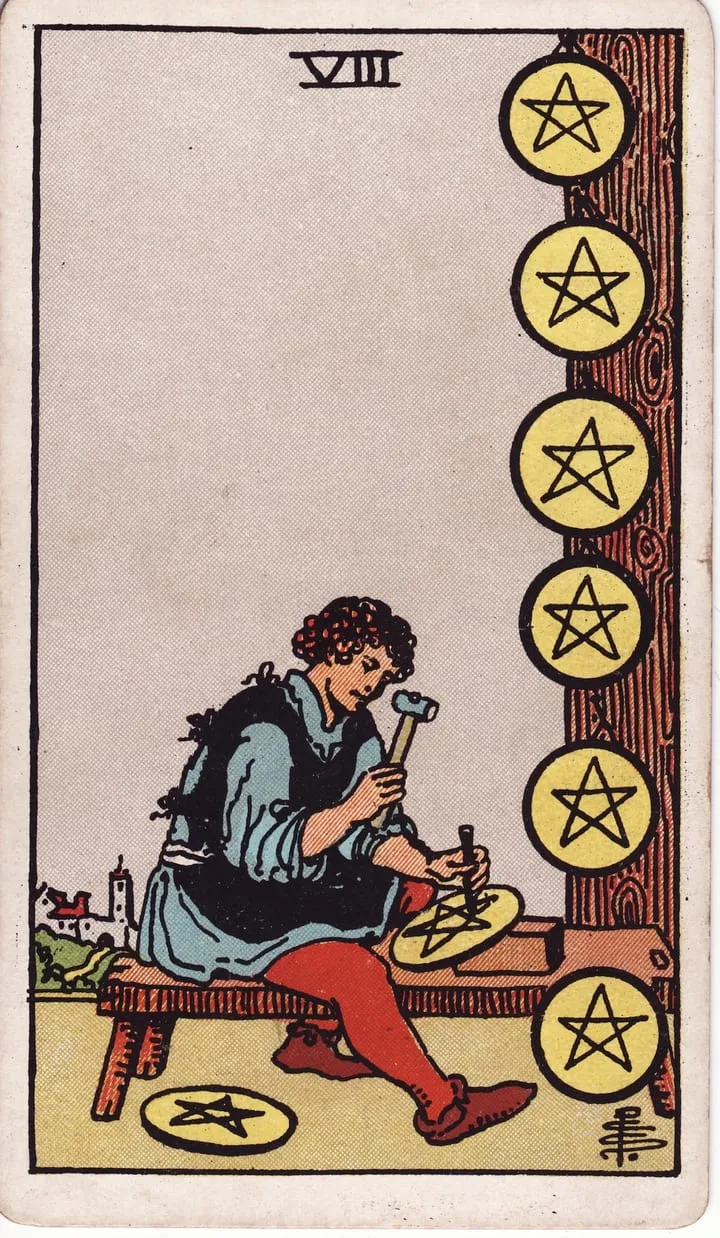
Craftsman at the bench
Head bowed, both hands busy, he is fully inside the task. He stands for attention: the kind of focus that turns ordinary effort into real skill.
Coin being carved
The star is still being cut. This coin is work in progress, a reminder that every finished piece was once half done.
Coins on the post
Finished coins line the post, all alike. Waite reads them as trophies: proof of effort, and of improvement through repetition.
Coin on the ground
One coin lies below the bench, waiting its turn. There is always more to practice.
Distant town
The town sits far off: the wider world, set aside for now.
In context
- General: keep practicing. Progress comes from consistency more than big leaps.
- Love: the relationship grows through attention to small things. Can you bring home the same patience you bring to your work?
- Career: a time to sharpen your skills, take a course or learn from someone more experienced. Good work done quietly tends to speak for itself.
- Money: a reflection on how your skills support you. Time spent getting better at something is rarely wasted.
- Self: what skill would you enjoy getting better at, slowly?
Light and shadow
- Light: craftsmanship, concentration, patience, honest pride.
- Shadow: never good enough, no life outside the work.
Common misreading
Seeing the Eight as a picture of drudgery. Look at his face: he is absorbed, even content. The card only turns heavy when it appears reversed or among cards of strain.