Swords · Five · Air
Five of Swords
After the argument. Someone holds the swords, and everyone pays something.
How it feelsBruised, uneasy, on edge.
What it asks of youSome wins cost more than they give. Ask what you truly want.
Upright
- hostility
- winning at a cost
- pride
- humiliation
- walking away
Reversed
- making amends
- second thoughts
- grudges that linger
- ending the fight
- letting pride go
The picture
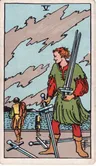
A young man in a green tunic and red sleeves stands in the foreground on a stretch of bare ground by the sea. He looks over his shoulder with a small, satisfied smile. Two swords rest on his left shoulder, and his right hand holds a third with its point to the ground. Two more swords lie on the ground nearby. Further off, two figures walk away toward the water, heads down; the smaller one seems to cover their face. Ragged gray clouds streak across a pale blue sky.
Waite describes “A disdainful man” watching “two retreating and dejected figures”, and adds: “He is the master in possession of the field.”
Meaning
The Five of Swords is the card of a conflict that has just ended badly. One side has collected the swords, and the others have left the field. On paper there is a winner. But the scene feels empty: no one is celebrating together, and the people who mattered are walking away.
Upright, the card often points to arguments, rivalry or power games where someone ends up feeling small. It may show you as the one who insisted on being right, the one who gave up and left, or someone watching from the side. Each position asks something different. If you are holding the swords, ask what the win has cost you in trust and goodwill. If you are walking away, it may be wise to leave a fight that cannot be won fairly. Either way, the card invites you to look at how you handle disagreement, not just at who came out ahead. Waite’s meanings for this card are very harsh; this page reads it more gently, as a lesson about conflict rather than a forecast of disgrace.
Reversed
Reversed, the fight may be winding down. Someone wants to put the swords away, apologize, or start over. That can be a real chance to repair things. At other times things have only gone quiet. The words have stopped, but the hurt has not, and it slips out in small, sharp ways. Be honest about which one you are in, and if you carry guilt or hurt from an old quarrel, it may be time to talk it through with someone you trust.
Symbols
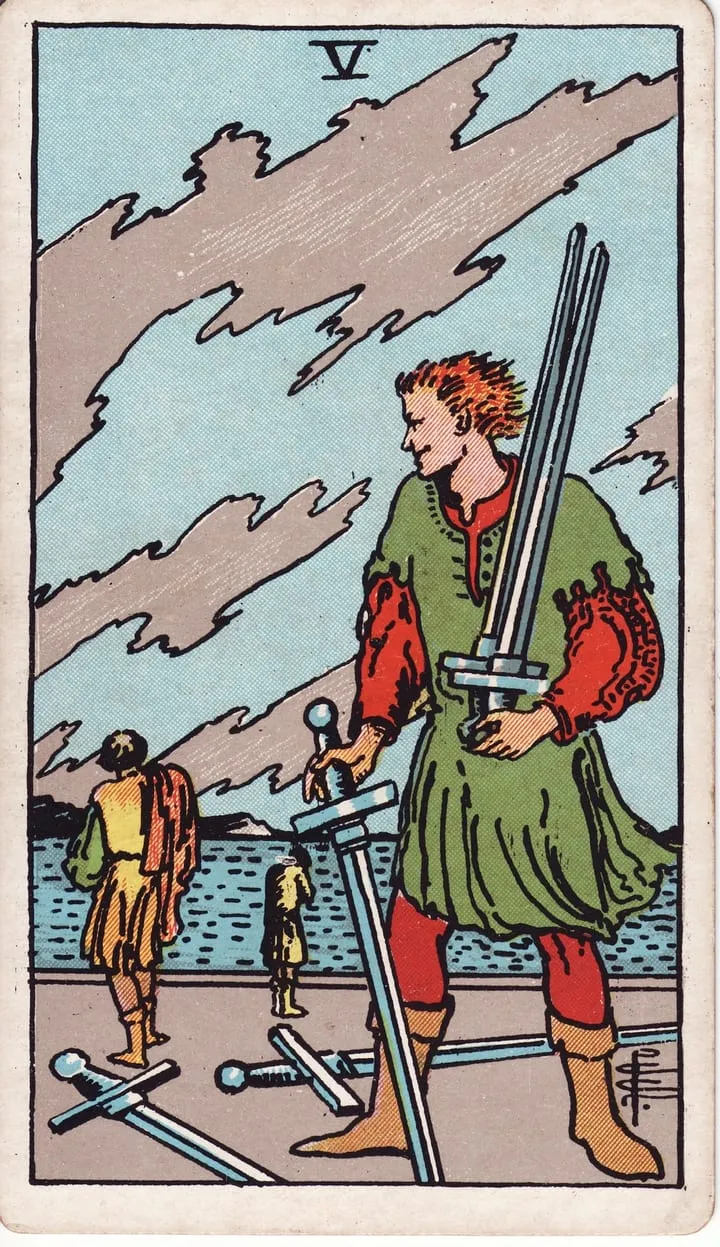
Man looking back
He smiles as the others leave. He has won something, yet he stands alone, watching the people he beat instead of anyone beside him.
Swords he holds
He keeps three swords for himself. Winning by collecting everything can leave you holding more than you can use.
Figures walking away
Two figures leave toward the water. Walking away can be defeat, or a quiet choice not to keep fighting.
Swords on the ground
Two swords lie where they were dropped: arguments abandoned, effort that went nowhere.
Torn clouds
Ragged clouds: the air is still unsettled.
In context
- General: the dust after a fight. Count the cost before claiming the prize.
- Love: a quarrel that has turned into a scorecard. Someone has to put down the first sword.
- Career: a tense meeting or a turf war. Ask whether the point is worth the goodwill it costs.
- Money: a dispute over shares or terms. Fairness keeps relationships intact.
- Self: are you being hard on someone, or on yourself, to feel in control?
Light and shadow
- Light: fair play, humility, leaving with dignity.
- Shadow: gloating, sarcasm, keeping score.
Common misreading
Assuming you are the one who lost. The card has three kinds of figure in it, and you could be any of them. Sometimes the most useful reading is the uncomfortable one: that the person holding the swords is you.