Wands · Five · Fire
Five of Wands
Many voices, one field. Friction that tests and sharpens.
How it feelsRestless, keyed up, a little frustrated.
What it asks of youNot every clash is a fight. Find the shared goal in the noise.
Upright
- competition
- friction
- rivalry
- many voices
- testing skills
Reversed
- avoiding conflict
- hidden tension
- inner struggle
- things heating up
- clearing the air
The picture
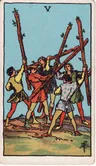
Five young men stand on rough, uneven ground, each lifting a long leafy staff. The staves cross and tangle in the air above their heads. Each wears different clothes: one in red, one in green, one in a tunic with blue spots, others in yellow and brown. No one is hurt, and no one is clearly winning. Behind them is only open blue sky.
Waite sees them “brandishing staves, as if in sport or strife”, and adds: “It is mimic warfare”.
Meaning
The Five of Wands is the card of friction and competition. After the calm of the Four, energy runs high and everyone pulls a different way. It looks chaotic, but nobody is truly attacking. It is more like a lively practice session or a heated meeting: lots of noise, many opinions, and no clear structure yet.
Upright, the card points to rivalry, debate, or simply too many ideas at once. Waite speaks of “the strenuous competition and struggle” of everyday ambition. This can be healthy. Competition sharpens skills and tests ideas. The question is whether the energy goes anywhere. A little order, such as clear roles, turns to speak or a shared aim, can turn scattered effort into progress.
Reversed
Reversed, the struggle may move inward. You might avoid a needed disagreement and let tension simmer under the surface, or argue with yourself instead. In other cases the friction grows past healthy competition and starts to feel personal. Some readers also see the reversal as the noise dying down. Either way, ask what is really being contested, and whether it is worth the energy.
Symbols
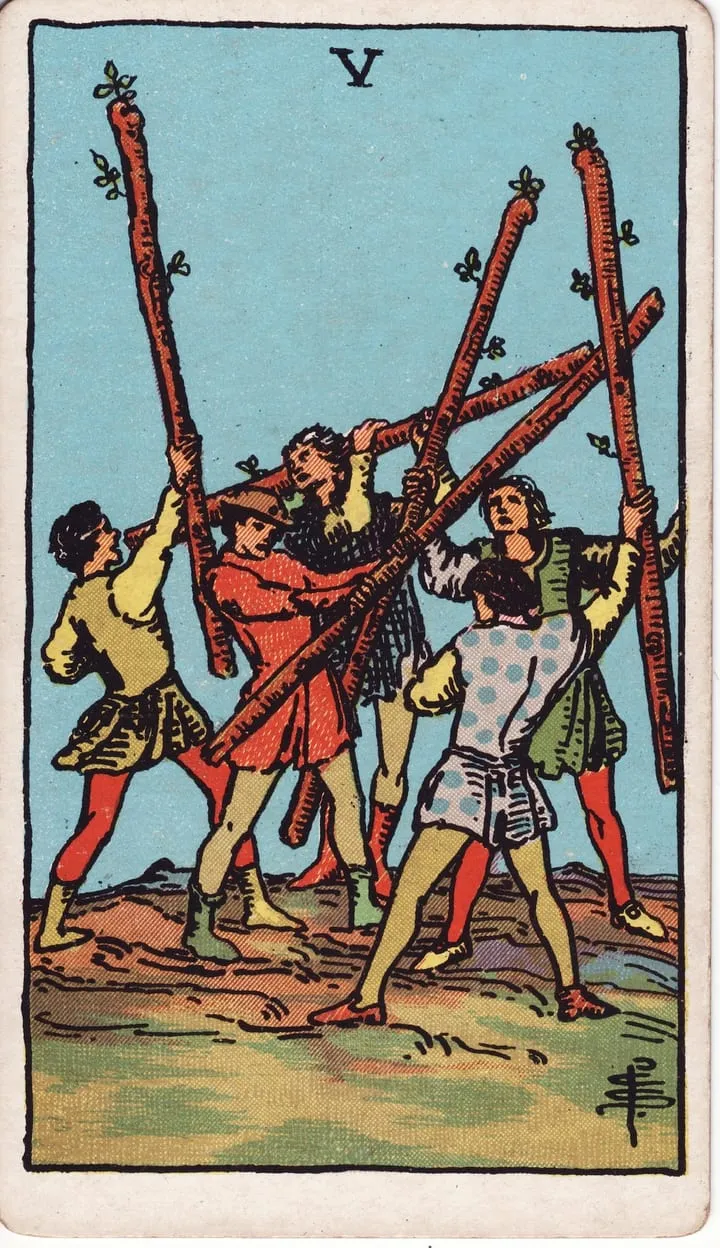
Five young men
Five similar figures, none of them a clear leader. They are commonly read as equals: peers, colleagues or rival ideas, each wanting to be heard.
Raised staves
Every staff is held high, and none lands a blow. The gesture looks more like display or play than real harm.
Crossed staves
Where the staves meet, they block each other. Effort spent pushing against others leaves little for building anything.
Different clothes
Each figure is dressed differently. Many readers see different styles, backgrounds and points of view meeting at once.
Rough ground
Uneven ground: nothing settled yet.
In context
- General: friction and competing views. Look for the shared goal.
- Love: small arguments or a tug of war. Talk it through before it hardens.
- Career: competition, crowded meetings, rival ideas. With some structure, the ideas can improve each other.
- Money: many demands on the same resources. Sort out priorities calmly.
- Self: are you at odds with yourself? Name the voices one by one.
Light and shadow
- Light: healthy competition, honest debate, energy, testing ideas.
- Shadow: conflict for its own sake, wasted effort, never agreeing.
Common misreading
Reading the Five as enemies or a real fight. Look closely: no one is wounded and no one has fallen. It is friction and rivalry, and they can be worked with.