Swords · King · Air
King of Swords
Clear thinking put to work for fair and firm decisions.
How it feelsSteady, detached, decisive.
What it asks of youJudge fairly, and remember the people your decisions touch.
Upright
- command
- firm decisions
- fairness
- clear reasoning
- high standards
Reversed
- control
- harshness
- unfair rulings
- cleverness used to win
- closed mind
The picture
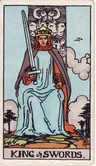
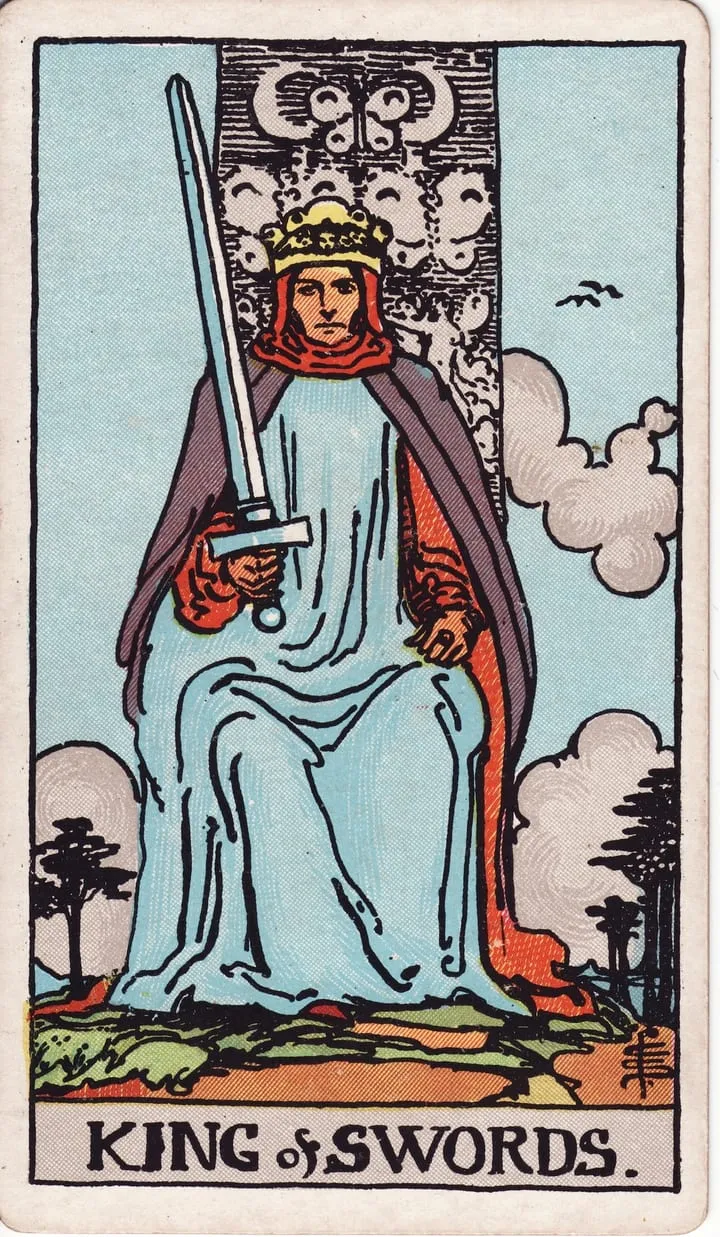
A king sits facing us on a stone throne, holding a bare sword upright in one hand, tilted slightly to the side. He wears a crown, a red hood and a long blue robe under a purple cloak. Butterflies, crescent moons and small faces are carved on the high back of the throne. Clouds and a few tall trees sit low behind him, and two birds fly at the right.
Waite writes: “He sits in judgment, holding the unsheathed sign of his suit.”
Meaning
The King of Swords is the mind in charge. He has learned to think clearly and now uses that skill to lead, judge and decide for others as well as himself. As an energy, it is the part of you that can weigh evidence, hold a standard and make the call. As a person, he may be an expert, a manager or an advisor whose word carries weight because it is reasoned.
Waite links him to the card Justice and gives as his meanings judgment and its connections: “power, command, authority, militant intelligence, law”. Upright, the King asks for clear principles and decisions you can explain. Say what you mean, keep your word, and act the same in private as in public. His sword leans a little to one side; even good judgment needs checking now and then. Reason works best when it remembers there are people on the other end of it. Firm and fair can belong together.
Reversed
Reversed, the King’s strength turns hard. Logic is used to control or to win rather than to be fair, rules become more important than people, or a fixed opinion shuts out new facts. Waite’s reversed meanings are severe (“Cruelty, perversity, barbarity”), and modern readings usually describe a quieter coldness or misuse of position. If you meet this energy in someone else, stay calm and look for fair support. In yourself, ask what you might be missing.
Symbols
Upright sword
He holds his sword bare and nearly upright. It stands for decisions made in the open and backed by reason.
Steady gaze
He faces us directly, calm and hard to read. Judgment here begins with looking straight at the matter.
Throne carvings
Butterflies and crescent moons cover the throne’s high back: a mind that can change shape even while it rules.
Low clouds
Clouds sit low behind the throne. He rules above passing moods.
Two birds
Two birds: thoughts in balance.
In context
- General: make a fair, reasoned decision and stand by it.
- Love: honest, steady commitment, or a need for less analysis and more warmth.
- Career: leadership, expertise, setting standards, or advice from someone who knows the field.
- Money: decisions based on numbers and good counsel, not mood.
- Self: are your principles serving fairness, or only your need to be right?
Light and shadow
- Light: integrity, clear reasoning, fairness, responsible leadership.
- Shadow: rigidity, point-scoring, rules placed above people.
Common misreading
Assuming the card always means a powerful outsider who decides your fate, a judge or a boss. Often it is your own clear judgment the card is calling for.