Swords · Seven · Air
Seven of Swords
Slipping away with an armful of swords. Clever, or just evasive?
How it feelsWatchful, sly, a little nervous.
What it asks of youA clever plan still needs an honest heart behind it.
Upright
- stealth
- cunning
- going it alone
- cutting corners
- getting away with it
Reversed
- coming clean
- caught out
- second thoughts
- plan unraveling
- conscience
The picture
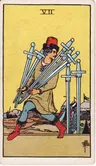
A man in a tan tunic and a red cap hurries across open ground on tiptoe, hugging five swords against his body by their blades. He glances back over his shoulder with a half smile. Behind him, two more swords stand upright in the ground. To the right are bright tents with pennants flying, and far off to the left a small group of figures stands near a puff of smoke. The sky is a flat, bright yellow.
Waite describes “A man in the act of carrying away five swords rapidly”, and adds that “A camp is close at hand.”
Meaning
The Seven of Swords is the card of the quiet getaway. The man is not fighting anyone. He is trying to get what he wants without being seen, slipping out of the camp while no one is looking. Swords are the suit of the mind, and here the mind is busy with plans, angles and shortcuts.
Upright, the card can describe smart strategy: working around an obstacle, keeping your plans to yourself, or doing something alone because the group would only slow you down. It can also describe evasion and dishonesty, from small white lies to avoiding a conversation you should have. Often the person being fooled is the one doing the fooling. Waite himself admits that “The design is uncertain in its import”, and that uncertainty is part of the message. Ask yourself: if this plan were seen in full daylight, would I still feel fine about it? Clever and honest can go together. When they split apart, this card tends to appear.
Reversed
Reversed, the plan meets daylight. Maybe the scheme stalls, or the secret slips. Maybe no one catches you at all, and keeping quiet simply stops feeling worth it. Some readers also see here the harder trick of fooling yourself. Owning up is uncomfortable, and it usually lightens the load.
Symbols
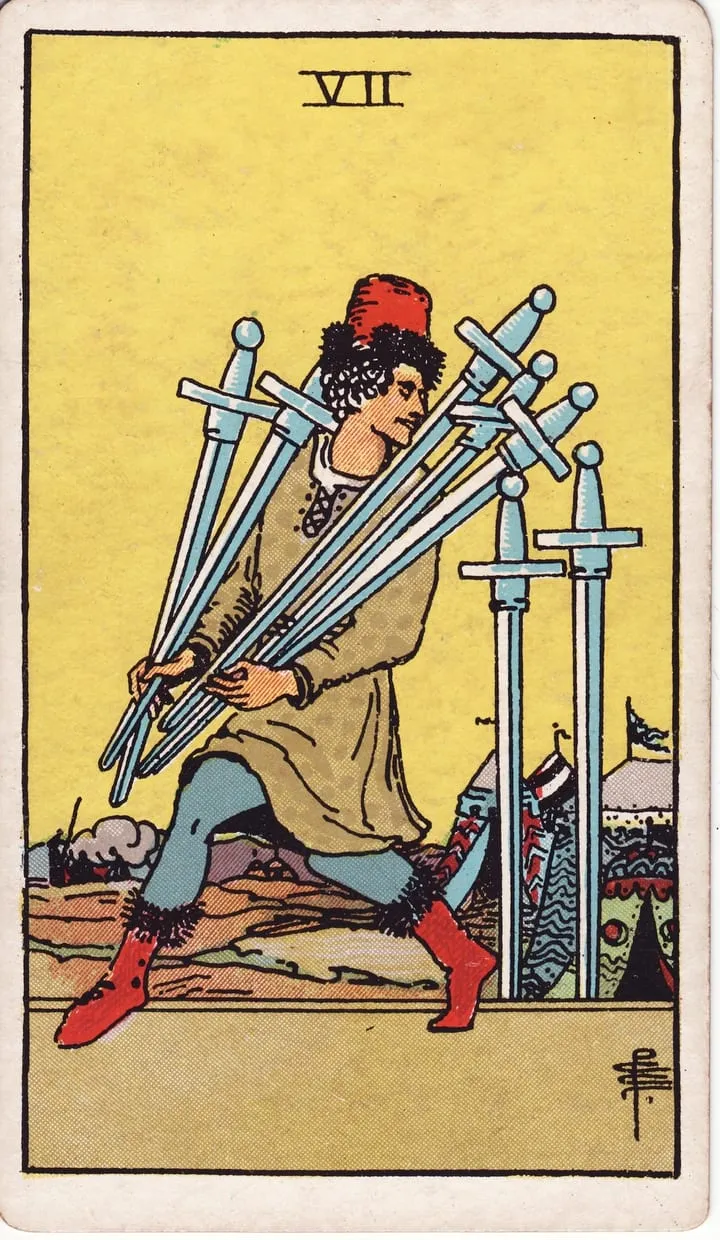
Man looking back
He tiptoes away while glancing over his shoulder. He is pleased, but also checking whether anyone has noticed.
Five swords carried
He clutches five swords by the blades, awkwardly. Taking more than you can hold safely is part of the risk.
Two swords left
Two swords stay planted in the ground. Something is always left behind, and it may tell the story of what happened.
Camp with tents
Tents and pennants close by: the group he is leaving, or slipping away from, without a word.
Tiptoe steps
Light, quick steps: hoping not to be heard.
In context
- General: a plan made quietly. Think about who it affects.
- Love: small evasions add up. Say the thing you have been saving for later.
- Career: a smart workaround may help. Make sure it would survive being explained to your team.
- Money: watch for shortcuts that seem too easy, and read the fine print.
- Self: is there a small lie you tell yourself to avoid a harder truth?
Light and shadow
- Light: resourcefulness, discretion, thinking a step ahead.
- Shadow: double-dealing, secrecy for its own sake, broken trust.
Common misreading
Reading the Seven as plain theft every time. Waite saw it as unclear, and the picture is full of mixed signals: a smile, a backward glance, two swords left behind. Sometimes it is about strategy and sometimes about avoidance, and the cards around it help tell which.