Swords · Ten · Air
Ten of Swords
A painful chapter reaches its end, and dawn is on the horizon.
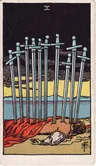
How it feelsSpent, sore, quietly relieved.
What it asks of youAn ending, fully accepted, is where rising begins.
Upright
- a clear ending
- hitting bottom
- painful truth
- surrender
- the worst behind you
Reversed
- slow recovery
- standing again
- holding on too long
- reopening old wounds
- a passing upturn
The picture
A figure lies face down on a shore, partly covered by a red cloth, with ten swords standing upright in their back. Above, the sky is black. Below the dark, though, a band of yellow light spreads along the horizon, over calm water and low hills. Keep that light in view: the scene is at its darkest and already turning.
Meaning
The Ten of Swords is the card of an ending you cannot argue with. A plan, a relationship, a belief or a long struggle has reached its limit. Swords are the suit of the mind, and ten blades where one would do say something too: this is finished, and there is nothing left to fight about.
Waite notes that it “is not especially a card of violent death”, and lists pain, tears and sadness instead. Those feelings deserve room. Yet the picture is careful to show the dawn. Once the worst has happened, the waiting and dreading stop, and recovery can start. Upright, the card asks you to accept the ending honestly instead of reopening it again and again. Rest. Let others help you carry what remains. Notice that you are still here, and that the light is coming up whether or not you feel ready. If the weight feels like too much, reach out to someone you trust and let them sit with you through it.
Reversed
Reversed, the figure begins to rise. Recovery is slow but real: you sit up, take stock and start again with what you learned. The reversal can also show resistance, such as holding on to something already over, or retelling an old hurt until it feels fresh. Waite’s reversed list is surprisingly bright, “Advantage, profit, success”, with the warning that “none of these are permanent”. Take the upturn gently and build on it slowly.
Symbols
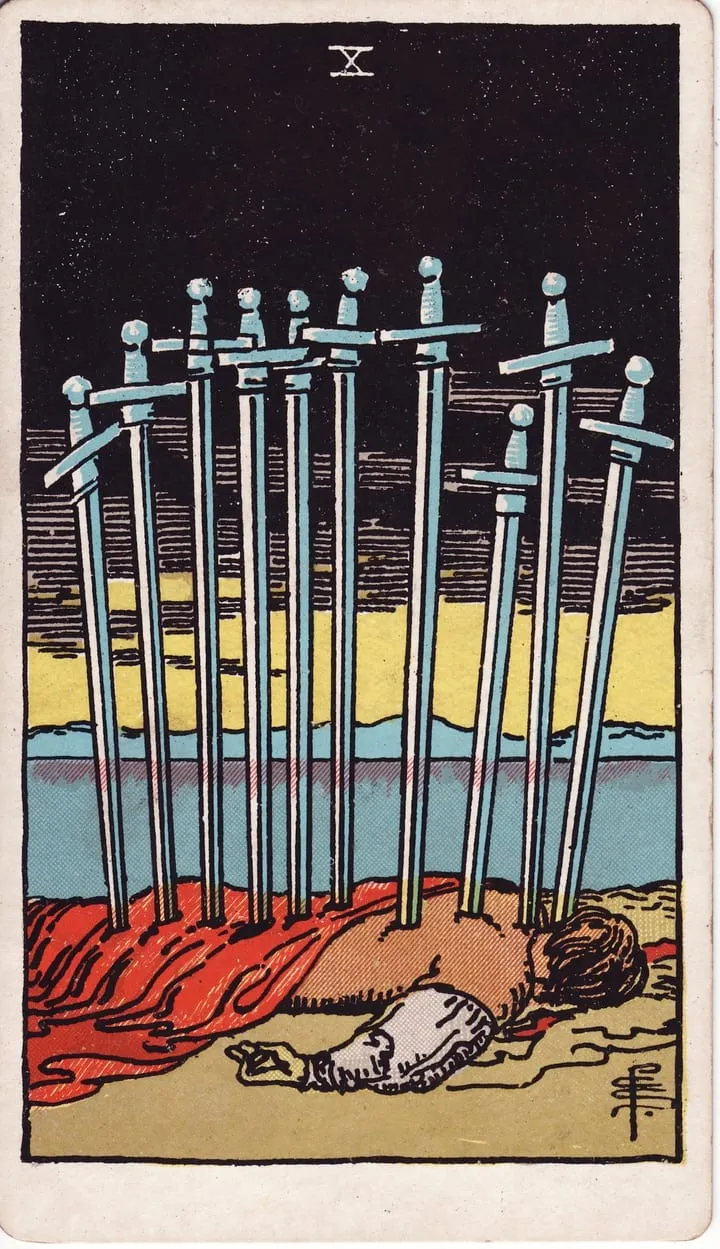
Ten swords
Ten blades in a row mark a full stop. The suit of the mind has said all it can, and the struggle is over.
Fallen figure
A figure lies still on the shore, face down. This is the moment of surrender, when the effort to hold everything together ends.
Red cloth
A red cloth lies across the figure and the ground. Its color carries the heat of the pain, now spent.
Yellow horizon
Under the black sky, a band of yellow light. The night is ending, even if the figure cannot see it yet.
Calm water
Still water: the storm has passed.
In context
- General: something has run its course. Accept it, rest, then look toward what can begin.
- Love: a relationship or a hope that has ended. Grieve it fully; healing starts there.
- Career: a project, role or approach that is finished. Keep the lesson and let the rest go.
- Money: a low point that shows clearly what must change. Begin with small, steady repairs, and get qualified advice where you need it.
- Self: what are you still carrying that is already over?
Light and shadow
- Light: honest acceptance, the relief of a clear ending, resilience, making room for what is next.
- Shadow: dramatizing the pain, refusing closure, defining yourself by the fall.
Common misreading
Taking the Ten as a literal threat to life or a prophecy of ruin. It describes the feeling of being completely spent, and the fact that a hard chapter is closing. Read it together with the light at the horizon.