Major Arcana · 4 · Fire
The Emperor
Structure, responsibility and steady authority that keeps things standing.
How it feelsSteady, serious, assured.
What it asks of youGood structure supports life. It should not replace it.
Upright
- structure
- stability
- leadership
- responsibility
- protection
Reversed
- rigidity
- control
- stubbornness
- misused power
- lack of discipline
The picture
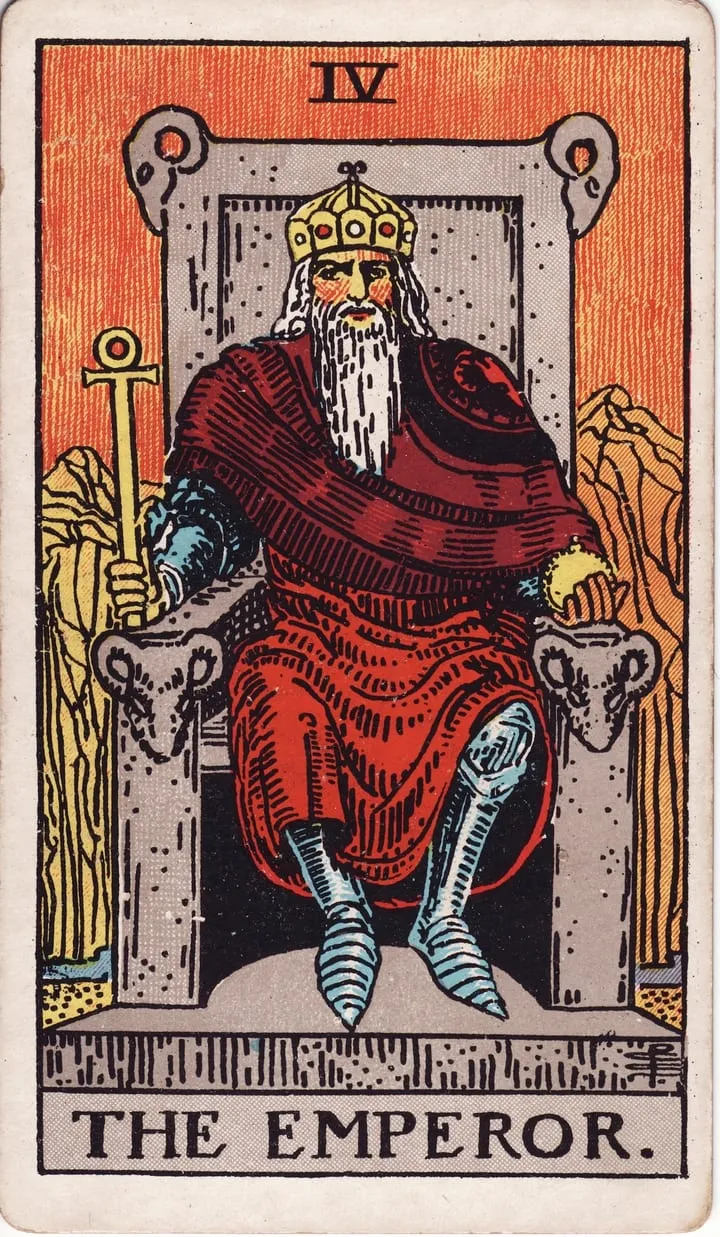
An old king sits on a heavy stone throne and looks straight out. His face is stern, and a long white beard falls over his chest. The throne is carved with rams’ heads. He holds a golden scepter shaped like an ankh in one hand and a golden orb in the other. Under his red robe he wears armor, and his metal-clad legs show below the hem. Behind him rise bare, rocky mountains under an orange-red sky.
Waite calls him “executive and realization, the power of this world.”
Meaning
The Emperor is the builder of order. After the Empress brings growth, he gives it shape: plans, rules, boundaries and the discipline to keep them. He stands for leadership, responsibility and the steady effort that makes things last. His number is four, the number of the square and of solid ground.
Upright, the card suggests taking charge in a calm and fair way. Make a plan, set clear limits, and follow through. It can also point to a father figure, a boss, or any person or system that offers protection through structure. His authority works best when it is earned and used for others.
Reversed
Reversed, structure tips into rigidity or falls apart. Control can turn into a need to dominate, rules can be kept for their own sake, or authority can be used without care. The opposite can happen too: no plan, no limits, and no one willing to take responsibility. Ask whether the rules in your life still serve you, or whether you are serving them.
Symbols
Rams’ heads
Waite notes the throne’s arms are “fronted by rams’ heads.” The ram is the sign of Aries, his sign: drive, initiative and the will to lead. Four rams’ heads appear on the throne.
Ankh scepter
Waite calls the scepter “a form of the Crux ansata”, the ankh, an old Egyptian sign of life. He holds power and life in the same hand.
Golden orb
The orb in his other hand stands for the world he governs. It is commonly read as rule over practical, earthly things: work, money, land and law.
Armor under the robe
He wears armor beneath his robe. Calm on the outside, he is ready to defend what he has built, and the people inside it.
Bare mountains
Bare peaks rise behind him. A common reading: firm ground, and a hard landscape that only steady effort can shape. What he has, he built.
Stone throne
A square stone throne: stability.
In context
- General: get organized. A plan and a few clear rules will help.
- Love: commitment and reliability. Check that protection does not turn into control.
- Career: leadership, management, working within a system. Take responsibility, and be fair with it.
- Money: budgets, long-term plans, steady habits. Structure is your friend here.
- Self: build routines that hold you up. Discipline can be a form of self-respect.
Light and shadow
- Light: leadership, stability, protection, follow-through.
- Shadow: control, coldness, stubbornness, power without empathy.
Common misreading
Reading the Emperor only as “a strict man.” The card can describe a person, but more often it describes a quality you can use yourself: the ability to set up a structure and hold it. A good Emperor is firm and fair, not cold.