Major Arcana · 0 · Air
The Fool
A first step, eyes on the sky and not yet on the ground.
How it feelsLight, excited, curious.
What it asks of youStart before you feel ready, but watch where you step.
Upright
- beginnings
- trust
- curiosity
- spontaneity
- a leap into the unknown
Reversed
- carelessness
- hesitation
- drifting
- avoiding responsibility
- a risk not looked at
The picture
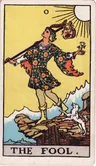
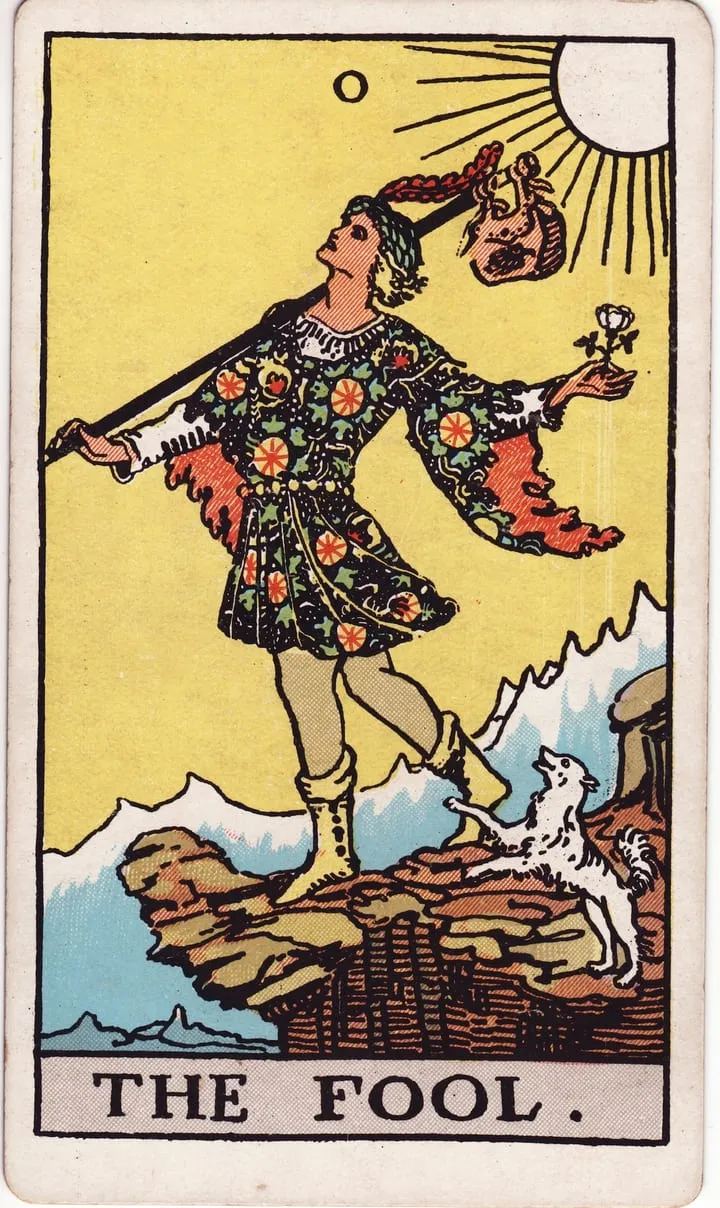
A young man in a bright, patterned tunic stands on a rocky height with one foot already moving. He looks up at the sky, not down at the drop in front of him. He holds a white rose in one hand and a staff over his shoulder with a small embroidered bag hanging from it. A small white dog jumps at his heels, and the sun shines behind him over snowy mountains.
Waite describes him as “a prince of the other world on his travels through this one” and, more simply, as “the spirit in search of experience.”
Meaning
The Fool is the start of something before you know how it ends: a new job, a move, a relationship, a project with no recipe. The card is about the value of trying before you have every answer, and about how easily that same openness turns into not paying attention.
Upright, it says the door is open and it is worth walking through. It favors curiosity over caution and trusting the process over controlling it.
Reversed
Reversed, the energy is the same but it flows badly. Either you leap without looking (acting on impulse, ignoring a real risk, calling it “freedom” when it is avoidance), or you do not leap at all and stay at the edge, waiting for a certainty that will not come.
Symbols
The sun behind him
The sun is behind him, not ahead. Waite says it “knows whence he came, whither he is going, and how he will return by another path.” He is carried by something he cannot see.
Looking up
He is looking up and out, at the sky. Waite: he surveys “its expanse of sky rather than the prospect below.” Hope, or not watching your feet: the reading depends on the cards around it.
White rose
A white rose held lightly. Commonly read as a clean intention, desire that has not yet been tested.
The small bag
The small bag on his staff is all he carries. Waite: it is “inscribed with dim signs, to shew that many sub-conscious memories are stored up in the soul.” He travels light, but not empty.
Edge of the cliff
The drop is one step away. Waite says the edge “has no terror” for him. Whether that is courage or carelessness is the whole question of this card.
White dog
Waite only says the dog “is still bounding.” Readers see it as a companion, an instinct, or a warning bark. The card does not decide for you.
Snowy peaks
Snowy peaks far off: challenges still ahead, visible but not yet part of the trip.
In context
- General: a door is open. Step through, and check the ground as you go.
- Love: something new and unforced, or a heart ready to open again. Lightness is lovely; commitment still takes time.
- Career: a new role, a change of field, an untested idea. Keep the enthusiasm and add a basic backup plan.
- Money: the urge to try something new can mean spending without thinking. Separate money you can afford to lose from money you need.
- Self: a new chapter. You do not need all the answers, only honesty about what you are curious about.
Light and shadow
- Light: courage to start, openness, not letting fear of mistakes block growth.
- Shadow: jumping without looking, dodging responsibility, calling escape “freedom.”
Common misreading
Reading the card as “you are being foolish.” In the Rider-Waite-Smith deck the Fool is not stupid; he is new, and the card asks whether that newness is brave or careless in this situation.