Major Arcana · 5 · Earth
The Hierophant
Tradition, teaching and shared belief, passed from one generation to the next.
How it feelsRespectful, grounded, earnest.
What it asks of youLearn the tradition well, then decide which parts are truly yours.
Upright
- tradition
- learning
- guidance
- community
- shared values
Reversed
- questioning rules
- personal beliefs
- nonconformity
- rigid dogma
- empty ritual
The picture
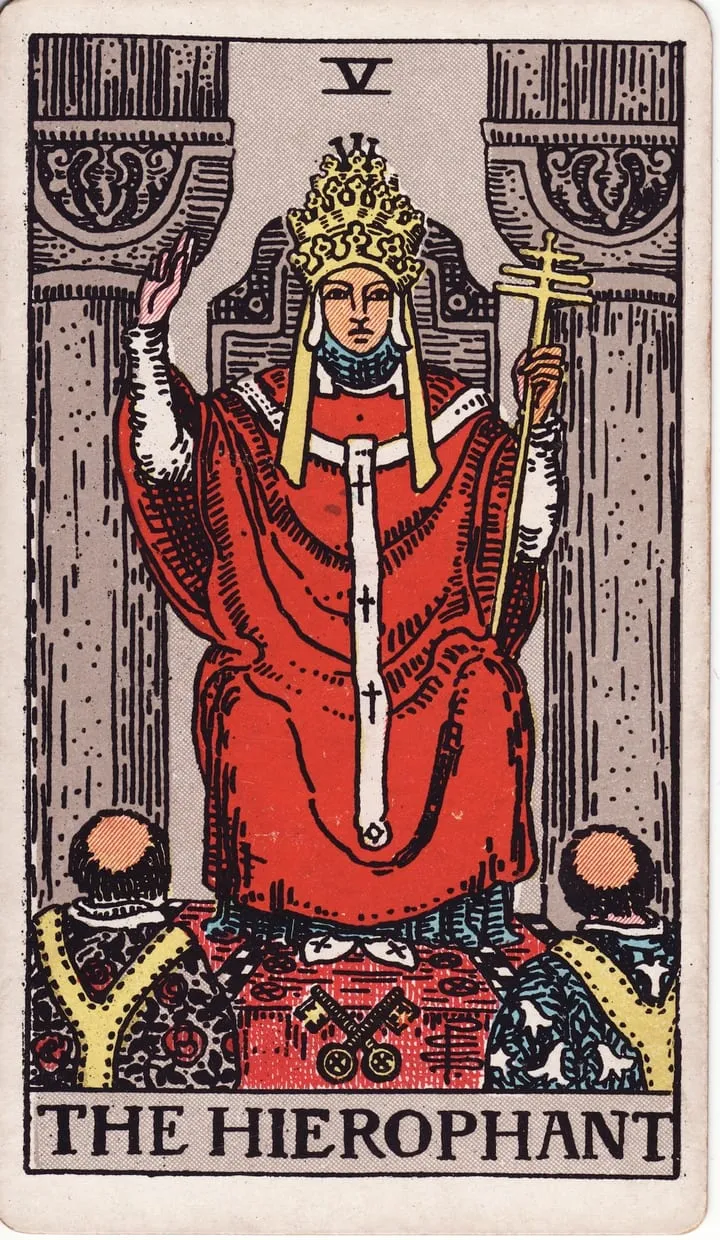
A figure in a red robe and a tall triple crown sits on a throne between two gray stone pillars. His right hand is raised in blessing, and his left holds a golden staff topped with a triple cross. Two crossed keys lie at his feet. Before him kneel two tonsured ministers with their backs to us, one robe patterned with roses, the other with white lilies. A white band marked with crosses runs down his robe.
Waite calls him “the ruling power of external religion”, where the High Priestess keeps the inner, hidden side.
Meaning
The Hierophant is the teacher and the keeper of tradition. He stands for institutions, shared beliefs, rituals and the structures through which knowledge is handed down: schools, faiths, families and professions. Where the High Priestess keeps knowledge hidden, the Hierophant makes it shared, taught and public.
Upright, the card suggests learning from those who came before. A mentor, a course, a proven method or a community can help you. It also covers commitments made in public, such as ceremonies and vows, where shared values matter. There is real value in belonging to something larger than yourself.
Reversed
Reversed, the card questions the rules. You may feel boxed in by expectations, or ready to find your own way. That can be healthy growth. It can also point to the other extreme: following a system so closely that you stop thinking for yourself, or a teacher who confuses authority with truth. The healthiest path often lies between the two: respect for what you were given, and freedom to question it.
Symbols
Raised hand
His right hand is lifted in blessing. Waite says the sign separates “the manifest and concealed part of doctrine”: what is taught openly and what is kept back.
Crossed keys
Waite calls him “the power of the keys.” The keys open doors to knowledge and to belonging. The card asks who holds them, and how they are shared.
Two kneeling figures
Two followers kneel before him. They show learning passed from teacher to student, and the comfort of belonging to a group.
Triple crown
His crown has three tiers. A common reading: authority over three levels, such as body, mind and spirit. It shows the weight of an office carried for others.
Gray pillars
Plain gray pillars, not the High Priestess’s black and white. Here the knowledge is public, built into walls everyone can see.
Triple cross
A staff with three crossbars: religious office.
In context
- General: the known path works well right now. Ask for guidance.
- Love: commitment, shared values, perhaps a formal step. Also notice whose expectations you are following.
- Career: training, qualifications, mentors, established organizations. Learn the system before you change it.
- Money: conventional, proven approaches. Qualified advice is worth seeking.
- Self: notice which beliefs you chose and which you inherited. Both can be worth keeping.
Light and shadow
- Light: learning, belonging, guidance, meaningful ritual.
- Shadow: dogma, conformity, blind obedience, judging those who differ.
Common misreading
Reading the card as only about religion. The Hierophant covers any tradition or institution, including school, work and family. It does not ask you to agree with everything, only to understand it.