Major Arcana · 1 · Air
The Magician
Everything you need is on the table. The question is whether you use it.
How it feelsFocused, confident, alert.
What it asks of youName what you want, then use what you already have.
Upright
- skill
- focus
- willpower
- resourcefulness
- making things happen
Reversed
- scattered energy
- untapped talent
- manipulation
- overpromising
- self-doubt
The picture
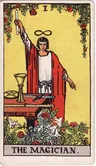
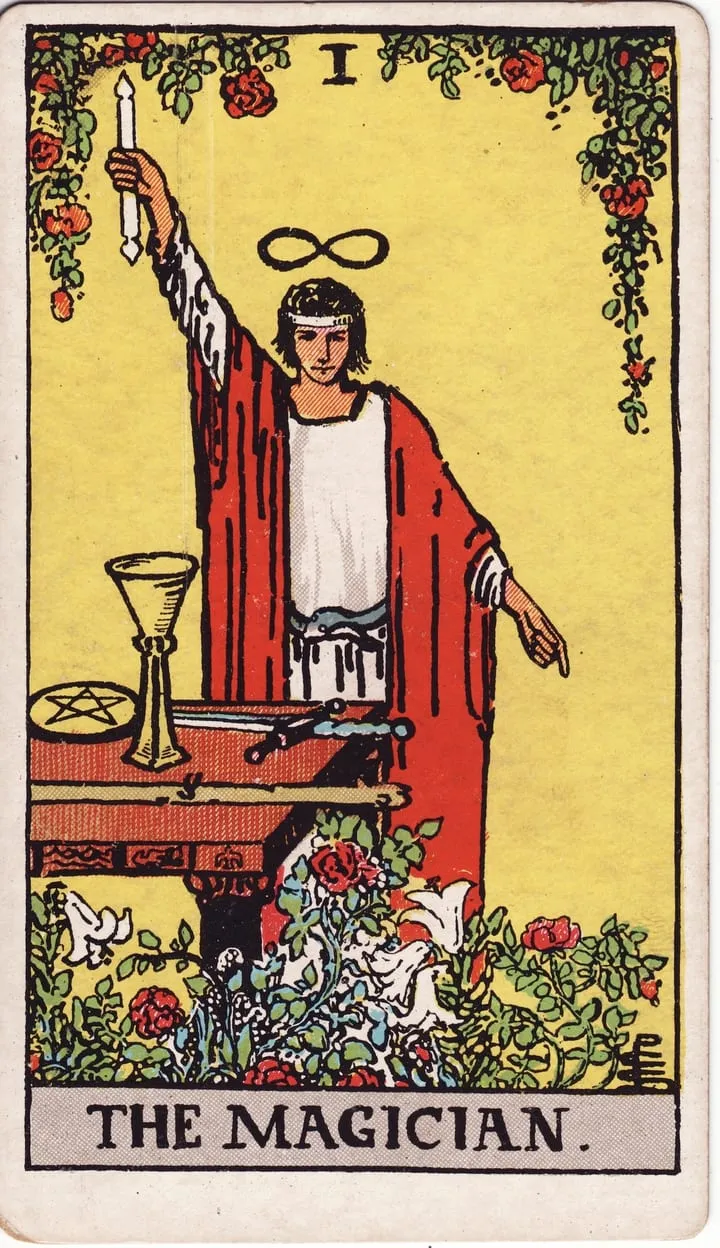
A young man in a white tunic and a red robe stands behind a table. One hand lifts a white wand to the sky and the other points down at the ground. A sideways figure eight floats over his head, and a band circles his waist. On the table lie a cup, a coin marked with a star, a sword and a wand. Red roses hang above him, and roses and white lilies grow at his feet, all against a bright yellow sky.
Waite says the four objects “lie like counters before the adept, and he adapts them as he wills.”
Meaning
The Magician is the moment an idea turns into action. After the Fool’s open step, this card is about focus: knowing what you want and bringing your skills, tools and attention to bear on it.
Upright, it suggests you have more to work with than you think. The card favors a clear intention, a first concrete move and the confidence to speak up for your plan. It is less about luck and more about using what is in front of you. Think of it as the gap between wanting something and starting to work on it.
Reversed
Reversed, the skill is still there but it is not pointed anywhere useful. Energy may be spread across too many plans, or talent may sit unused out of doubt. The card can also show the shadow side of persuasion: promising more than you can deliver, or using charm to steer people rather than to help them. Ask whether the plan is real, or only well presented.
Symbols
Wand raised high
His raised hand draws something down from above, and his lowered hand points to where it lands. Waite calls this “the descent of grace, virtue and light.” Ideas become real when they reach the ground.
Tools on the table
A cup, a coin, a sword and a wand: the signs of the four suits, and of feeling, matter, thought and action. Everything he needs is already laid out.
Figure eight
The sideways eight over his head is commonly read as endless energy and possibility. What he draws on does not run out, as long as he keeps his attention on it.
White and red
The white tunic is often read as clear intention, the red robe as desire and drive. He wears both at once: purpose and passion in one person.
Roses and lilies
Roses and lilies frame the scene above and below. Waite says they show “the culture of aspiration”: hopes that are tended, like a garden, not left to chance.
Serpent belt
Waite calls the belt a serpent eating its own tail: renewal, and cycles that keep turning.
In context
- General: you have the means. Choose one aim and take the first real step.
- Love: clear, honest words help. Be wary of charm that is all surface, yours or someone else’s.
- Career: a good time to pitch, start or show your skills. Back the confidence with preparation.
- Money: resourcefulness over windfalls. Look at what you can build with what you already have.
- Self: notice your own abilities. You may be more capable than your doubts allow.
Light and shadow
- Light: focus, skill, initiative, turning ideas into results.
- Shadow: manipulation, showing off, many beginnings with no follow-through.
Common misreading
Reading the Magician as a trickster or a con. The card can carry that shadow, but upright it is about real skill and honest effort. The “magic” is attention and action, not illusion. Skill without honesty belongs to the reversed card, not the upright one.