Reading
How Positions Shape a Card
Each place in a spread asks its own question, and the card answers that question.
When you lay cards in a spread, each card lands in a place with a name: the past, the challenge, the advice. That name is a question. The card does not change, but what it says depends on the question it is answering.
A position is a question
“Past” asks what led here. “Challenge” asks what is in the way. “Advice” asks what might help. When you turn a card over, read the position’s name first and say its question in plain words. Then look at the card as a reply.
This keeps you from reading every card as a general forecast. A challenge card is not a verdict on your whole situation, only an answer to: what is making this harder?
the cards must be interpreted relatively to the subject
A card’s usual meaning is a starting point, not a script.
One card, many places
Take the Four of Cups. A young man sits under a tree, arms folded, looking at three cups on the grass while a hand from a cloud offers him a fourth. Its core is withdrawal, boredom, and an offer not yet noticed.
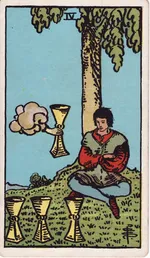 Four of Cups
Here it is in two common three-card spreads. Switch to the worked example to see how each place bends that core.
Four of Cups
What led here?
A stretch of feeling flat or uninterested that you have been carrying for a while.
Four of Cups
What is happening now?
You are turned inward, maybe tired of the options in front of you.
Four of Cups
Where is this heading if nothing changes?
More of the same: comfortable, a little stuck, and slightly bored.
Worked example
- Past: Four of Cups. A stretch of feeling flat or uninterested that you have been carrying for a while.
- Present: Four of Cups. You are turned inward, maybe tired of the options in front of you.
- Outcome: Four of Cups. More of the same: comfortable, a little stuck, and slightly bored.
Four of Cups
What is going on?
You are turned inward, maybe tired of the options in front of you.
Four of Cups
What is in the way?
Not looking up. Something worth considering may be within reach.
Four of Cups
What might help?
Step back on purpose. A short pause can clear your head before you choose.
Worked example
- Situation: Four of Cups. You are turned inward, maybe tired of the options in front of you.
- Challenge: Four of Cups. Not looking up. Something worth considering may be within reach.
- Advice: Four of Cups. Step back on purpose. A short pause can clear your head before you choose.
The card never changes. Its tone moves from a memory, to a mood, to an obstacle, to a suggestion, to a direction: the same card answering different questions.
Gentle cards in hard places, hard cards in gentle places
Positions matter most when the card and the question seem to pull apart.
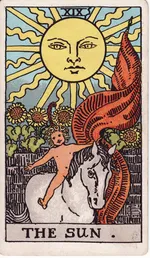 The SunAs the challenge: optimism that skips over a real problem, or a wish to keep everything pleasant.
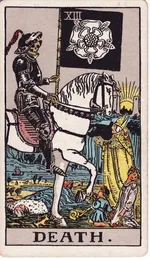 DeathAs advice: let this one end so something else has room.
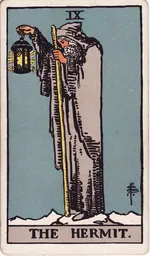 The HermitAs the outcome: a calmer, more inward stretch you might welcome.
A bright card as the challenge can be too much of a good thing; a heavy card as advice is rarely a punishment. When a card feels out of place, ask how it would answer that exact question if it were trying to be useful. Usually a reading fits both.
Time positions and theme positions
Time positions
Past, present, near future. They follow how a situation has moved. Read them as a story, and remember a “future” card shows a direction, not a fixed event. You still have choices.
Theme positions
What you think, what you feel, what others bring, what you can do. They look at one moment from several sides and do not run in order. Read them like portraits of one scene.
Many spreads mix both: the Celtic Cross has a past and a near future, and a place for hopes or fears. Knowing which kind you face keeps you from expecting a timeline where there is none.
When a card and its position clash
- Say the question out loud. “What is in the way?” is clearer than “challenge.”
- Start from the card’s core. Pick the keyword on its page that best answers the position’s question.
- Let the picture help. In the Four of Cups, the hand from the cloud is easy to miss. As advice, that detail may be the whole message.
- Do not force it. Leave an unclear card for a moment and read its neighbors. They often explain each other, as reading cards together shows.
Making your own positions
A position only needs to be a clear, open question. “What am I not seeing?” works well. “Will this work out?” works less well: it asks for a yes or no and pulls the reading toward prediction.
The three-card spreads guide has several sets you can borrow or adapt.
The heart of it
A card carries a meaning. A position carries a question. The reading happens where the two meet. Read the question first, and even an unfamiliar card has somewhere to land.
Next guide
Reading Cards TogetherHow cards echo, contrast, and lead into each other, so a spread reads as one story.