Spreads
The Two Paths Spread
A six-card spread for weighing two options side by side, calmly and on your own terms.
Some questions are not about what is happening but about what to choose: stay or go, this offer or that one, now or later. The Two Paths spread lays both options on the table at once, so you can look at them side by side instead of going back and forth in your head. It does not choose for you. It helps you see each option more clearly, and notice how you feel about it.
What the spread is for
Use it when you face a real choice between two options and have already done the practical thinking: work, study, where to live, how to spend your time, how to handle a conversation. For a yes-or-no question with only one option in it, a one-card draw is often enough.
Before you shuffle, name the two options in plain words and decide which is A and which is B. Waite’s advice to “formulate your question definitely” matters more here than in most spreads, because a vague choice gives vague cards. If you have three or more options, narrow them to the two you keep coming back to.
The layout and the positions
You sit at the foot of the spread. The two paths branch up and away from you, A on the left and B on the right, each with a second card above it. What matters most sits in the middle, between both paths. Tap a place to see its question.
Seven of Cups
How am I meeting this choice right now?
Many pictures of the future, hard to tell which are real. You may be daydreaming more than looking.
Ten of Pentacles
What is path A like, as I see it today?
Roots, family, things built over time. Staying looks steady and connected.
Four of Cups
What would I need to give, learn or accept to walk path A?
To notice what is already offered. Staying asks you to see home with fresh eyes.
Six of Swords
What is path B like, as I see it today?
A quiet crossing to calmer water. Moving looks less like an adventure, more like a gentle transition.
Strength
What would I need to give, learn or accept to walk path B?
Patient, gentle courage through the unsettled first months.
The Hermit
What is worth holding on to, whichever way I go?
Your own inner voice, heard in quiet.
Worked example
- Where you stand: Seven of Cups. Many pictures of the future, hard to tell which are real. You may be daydreaming more than looking.
- Path A: Ten of Pentacles. Roots, family, things built over time. Staying looks steady and connected.
- What A asks: Four of Cups. To notice what is already offered. Staying asks you to see home with fresh eyes.
- Path B: Six of Swords. A quiet crossing to calmer water. Moving looks less like an adventure, more like a gentle transition.
- What B asks: Strength. Patient, gentle courage through the unsettled first months.
- What matters most: The Hermit. Your own inner voice, heard in quiet.
The “asks of you” cards are often the most useful. Every path has a cost and a gift, and seeing the cost plainly can make a choice much easier. For a quicker look, the three-card version uses one card per option and one for what matters.
How to read it
Start with where you stand
Your own state colors everything else. A worried card here may mean you are reading both paths through worry.
Read path A as a pair
What does this path offer, and what does it ask in return?
Read path B the same way
Then compare across. A path full of Cups is likely about feeling, one full of Pentacles about daily life. See suits and elements.
Read what matters most last
It belongs to both paths. Hold both options up to it. And notice your own reaction: relief or disappointment when a card lands on one side is information too.
A worked example
Say you are deciding whether to stay in the town where you grew up (path A) or move to a city you have been visiting (path B). Switch the board above to “Worked example” to see the six cards in their places.
Putting it together. The Seven of Cups suggests the choice feels foggy partly because you are imagining more than looking. Both paths look livable: one rooted and full, the other a calm move forward. The difference is in what they ask.
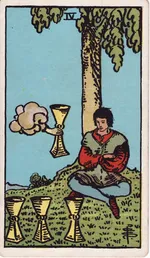 Four of CupsStaying asks you to stop overlooking what you have.
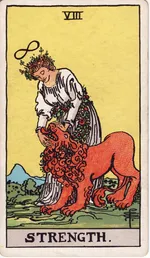 StrengthMoving asks for steady, gentle courage.
The Hermit in the middle points back to you: some quiet time alone with the question may help more than another list of pros and cons. The reading does not say which path is better. It shows what you would be signing up for either way.
Common pitfalls
- Treating it as a vote. Counting “good” and “bad” cards on each side misses the point. A hard card may simply name the effort a path needs, and effort is not a reason to say no.
- Changing A and B after the draw. Decide which is which before you shuffle, and keep to it.
- Drawing again until it agrees. If you keep redrawing, you may already know what you want. Let that be the answer.
- Letting the cards carry the decision. For choices with legal, medical or financial weight, talk to a qualified person. The cards help you reflect, not replace that advice.
- Forgetting card 6. It is easy to skip the middle, and it often holds the most useful thought.
To look at a single option more deeply, the Celtic Cross gives ten positions to one question. For reading the cards as one story, see reading cards together.
Next guide
Three-Card SpreadsFive simple three-card layouts, each with its positions and a short worked example.