Spreads
The One-Card Draw
The simplest spread: one question, one card, and a few quiet minutes with it.
The smallest spread, and one of the most useful: ask a question, draw one card, and spend a little time with it. No positions to juggle, no patterns to track. A good place to start, and a good habit to keep.
The answer to your question
Why one card is enough
One card often says a great deal, because it gets your full attention. You notice details you would skip in a bigger spread, and let its meaning connect to your day. It is also honest about what tarot does well: one image to think with, not a map of your future.
Asking the question
The question shapes the reading, even with one card. A clear question gives the card somewhere to land.
formulate your question definitely
Works well
Open questions about you. What do I need to keep in mind today? What is asking for my attention here? What would help me approach this conversation? What am I not seeing?
Works less well
Yes or no, or something outside your reach: “Will I get the job?” “Does she still think about me?” One card cannot carry that weight, and it pulls the reading toward guessing.
With no particular question, “What is worth noticing today?” is enough.
Drawing the card
Shuffle until it feels finished, cut, and take the top card, or fan the cards and pick one. What matters is being calm and paying attention. Decide first whether you read reversed cards; if not, simply turn an upside-down card upright. Reading reversals explains both.
Reading a single card
With one card, you can take your time. A simple order helps.
Look first
Before meanings, look at the picture. What is happening? Who is there? What catches your eye?
Notice your first reaction
Relief, curiosity, discomfort. Not the answer, but worth knowing. Intuition and projection looks at telling a quiet hunch from hope or worry.
Recall the core meaning
Each card page has a short line and a few keywords. Pick the one that fits your question best.
Connect it to the question
How might this card answer what you asked? Look for one plain sentence.
Let it go
No need to keep turning it over all day. Let it sit in the background.
A worked example
Worked example
What is worth keeping in mind at work this week?
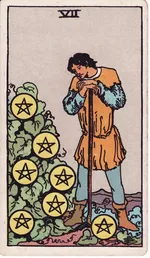 Seven of Pentacles
Look first. A young man leans on his staff and looks at a clump of greenery holding seven pentacles. He is not harvesting yet. He is pausing to see how things are growing.
First reaction. Maybe impatience. You want results, not waiting.
Connect it. The work you have put in may be growing, even if it is not ready to show. This week could be a time to look honestly at what is working and what is not, rather than pushing harder.
One sentence. “Pause, look at what I have planted, and give it time.”
That is a complete reading: not what will happen at work, but a way of looking at your week.
Making it a habit
Many people draw one card in the morning as a small moment of reflection.
- Keep it short. A few minutes is plenty.
- Keep a short note if you like. The date, the card, and your one sentence. Over weeks you will see which cards return and how your reading of them grows.
- Look back in the evening. The card sometimes makes more sense at the end of the day.
- Do not redraw because you dislike the card. The unwelcome one is often the one worth sitting with.
A card a day is also a gentle way to learn the deck, one familiar face at a time.
When one card is not enough
If one card raises more questions than it answers, draw a second to clarify it, or move to a small spread: three-card spreads are a natural next step, and the Celtic Cross lays out ten cards for a larger question.
But do not reach for more just because the first is unclear. Often a little more time with it is enough.
Next guide
The Two Paths SpreadA six-card spread for weighing two options side by side, calmly and on your own terms.