The system
Court Cards
Page, Knight, Queen and King as four stages of growth and four ways of acting.
Each suit has four court cards, Page, Knight, Queen and King: sixteen in all. Beginners often find them hardest, because each shows a person and it is not always clear who. A simple way in: treat the ranks as stages of learning or styles of acting, and let the suit say what is being handled.
Where the court cards sit
Waite saw the court cards as standing between the big ideas of the Major Arcana and the everyday events of the numbered cards. They are people, but also patterns of behavior you can recognize in others and in yourself.
a bridge of conventions
The four ranks
Beginner
Curious, open, learning. What am I discovering?
Young adult
Active, pursuing, intense. Where am I heading, and how fast?
Mature, inward
Receptive, steady, nurturing. How do I hold this from within?
Mature, outward
Directing, responsible, steady. How do I lead with this?
Page
The Page is a student of the suit: curious, sincere, a little untested, often bringing a message, a new interest, or an invitation to learn. The Page of Cups gazes at a fish rising from his cup, surprised by a feeling or an idea. Waite says of this card, “It is the pictures of the mind taking form.”
Knight
The Knight is the suit in motion: committed, bold, and apt to overdo it, pushing the suit’s energy as far as it goes. Their horses tell you a lot.
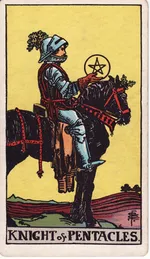 Knight of PentaclesA heavy, still horse: slow and dependable.
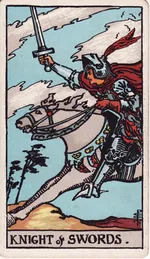 Knight of SwordsGalloping at full speed: quick, sharp, sometimes reckless.
Queen and King
Both have mastered the suit. The difference is the direction they face.
Queen: from within
She lives the suit’s qualities calmly, with quiet understanding and care. The Queen of Cups looks deeply into a closed cup, attuned to feeling. The Queen of Pentacles sits in a garden with a coin in her lap, practical and warm.
King: outward
He uses the suit’s qualities to guide, decide and take responsibility for others: experienced and stable, though he can become rigid. The King of Swords sits with an upright sword and a steady gaze: clear judgment.
The sixteen cards at a glance
Rank plus suit gives each card’s flavor.
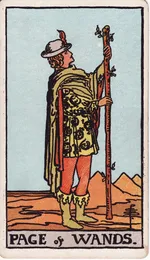 Page of WandsEager new idea
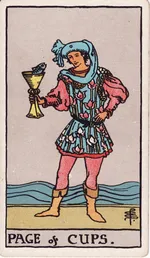 Page of CupsA tender feeling
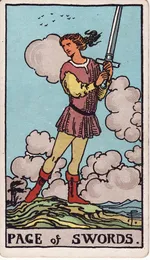 Page of SwordsCurious, alert mind
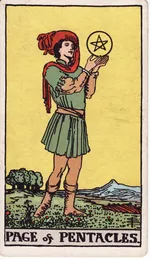 Page of PentaclesWilling to study
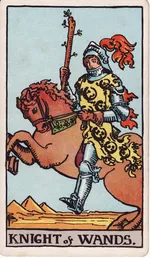 Knight of WandsBold adventure
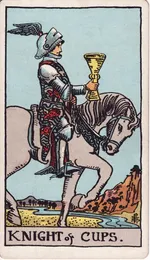 Knight of CupsRomantic pursuit
- Knight of SwordsCharging ahead
- Knight of PentaclesSlow and sure
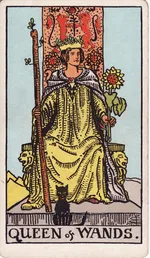 Queen of WandsWarm confidence
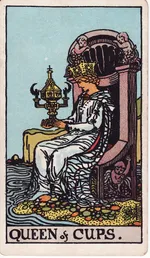 Queen of CupsDeep empathy
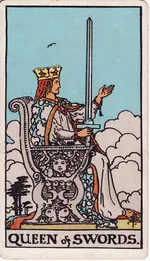 Queen of SwordsClear honesty
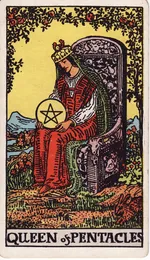 Queen of PentaclesPractical care
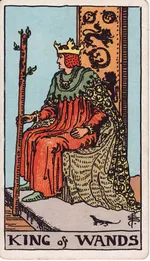 King of WandsVisionary leader
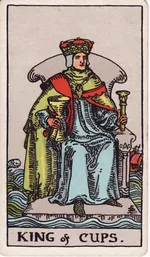 King of CupsCalm in feeling
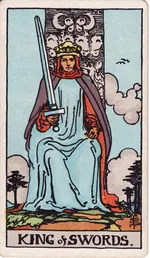 King of SwordsFair judgment
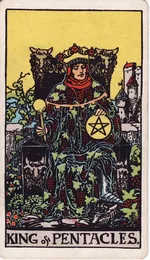 King of PentaclesSteady provider
Three ways to read a court card
A court card can mean several things. Try each and see which fits.
A part of you
It can show a way you are acting, or could act. The Queen of Swords might nudge you to say clearly what you think, kindly and without apology. A Page might remind you that it is fine to be a beginner.
Someone in your life
It can point to another person. Read it by how they behave, not by looks, age or gender: any person can be any court card. The King of Wands might be a friend whose energy and vision pull a group forward. The Knight of Cups might be someone who offers feeling and romance, maybe more than they can follow through on.
A situation or approach
It can describe how a situation is moving or asks to be met. A Knight may mean things are about to speed up; a King, that the moment calls for steady leadership, from you or someone else.
A worked example
Worked example
Should I start a small creative business?
As a part of you: a beginner’s attitude, curious, careful, eager to learn the practical side. As another person: a mentor or new contact studying the same field. As a situation: the idea is real but young, and the next step is learning and small, steady practice.
All three agree: this is the start, not the finish.
Reading several court cards together
When more than one court card appears, notice the ranks.
- Two or more Pages: a time of learning or of fresh news.
- Two or more Knights: things are moving quickly, maybe in more than one direction.
- Queens and Kings together: the matter may involve experience, authority or questions of who leads.
Then notice the suits, which tell you where the energy sits; see Suits and Elements. For how cards affect each other, see Reading Cards Together.