The system
Reading Reversals
What an upside-down card can mean, and several gentle ways to read one.
Sometimes a card comes out of the deck upside down. Readers call this a reversal. It is not a bad omen, and not simply the opposite of the upright meaning: it is the same card, seen from another angle.
Where reversals come from
When you shuffle, some cards end up facing the other way. Some readers also turn part of the deck on purpose first. Waite’s instructions for one method begin with exactly this:
turn some of the cards round, so as to invert their tops
Some decks show the difference clearly; others have borders or backs that make it hard to tell. Decide which way is “up” before you begin.
You can choose not to use them
Reversals are optional. Many experienced readers never use them: they read every card upright and let the position and the nearby cards bring out a card’s harder side when needed.
If you are starting out, leave reversals aside until the upright meanings feel familiar. When you are ready, decide before a reading whether you will read them, and keep that choice for the whole reading.
Several ways to read a reversed card
There is no single rule. Use one approach every time, or the one that fits the card and the question.
1. Blocked or delayed
The card’s energy is present but stuck, not yet through or meeting resistance.
2. Turned inward
The energy is private rather than public: something is happening inside you before it shows in the world.
3. Too much or too little
The card’s quality is out of balance, either overdone or missing.
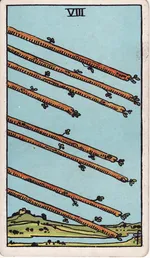 Eight of WandsBlocked: usually speed, now plans slowing or news that is late.
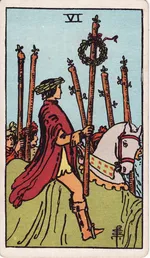 Six of WandsTurned inward: public recognition becomes a quiet, personal success, or a win not yet shared.
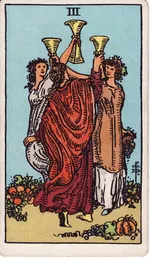 Three of CupsToo much or too little: celebration tipping over, or feeling left out of the circle.
4. The shadow side
Every card has a light side and a shadow side, and a reversal can bring the shadow forward.
5. Releasing or recovering
For harder cards, a reversal can mean the worst is passing.
6. A cue to look more closely
Some readers treat a reversal simply as a flag: pay extra attention here. It may be the heart of the reading, or where you are not yet seeing clearly.
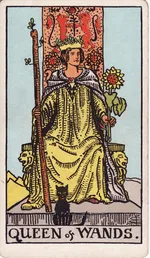 Queen of WandsShadow: warmth and confidence turn to self-doubt, or a need for attention.
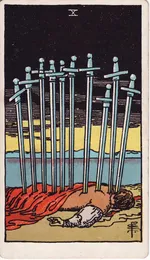 Ten of SwordsRecovering: getting back up after a painful ending.
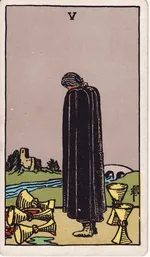 Five of CupsReleasing: turning from what was lost to notice what still stands.
Choosing among the approaches
With so many options, a reversal can seem to mean anything. Three questions narrow it down.
What does the picture look like upside down? Literally turn it and look.
Ace of Cups, upright
Water flows over the rim of the Ace of Cups: a heart that is full.
Ace of Cups, reversed
The water spills out of the cup instead. That image alone can suggest a feeling drained, or one poured out too freely.
What does the position ask? In a “what helps” position, a reversal often reads as something that needs attention before it can help. In a “what is passing” position, it can mean something already on its way out. See Positions.
What do the nearby cards say? If they are calm and hopeful, read the reversal gently: a delay, a small block. If they repeat its theme, that theme matters. See Reading Cards Together.
Each card page on this site has a “Reversed” section with a starting point for that card.
Two worked examples
Worked example
How do I recover after a hard few months?
 The Star
Upright, the Star is hope and healing. Read as “blocked,” the reversal might suggest you have not yet let yourself rest. Read as “turned inward,” healing may be happening quietly, even if you do not feel it yet.
Both point to the same next step: be patient with yourself, and go back to the small things that restore you.
Worked example
What is this pause asking of me?
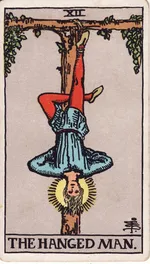 The Hanged Man
 already hangs upside down, so a reversal sets him upright. Some readers see this as the end of a pause, the moment to move again. Others see resistance to the pause: rushing ahead when stillness would help. The cards around it usually make clear which fits.
Keep it calm
A reading with several reversals is not a warning. Usually some things are still in process, or some energy is held back for now. Read them with the same calm curiosity as upright cards: they are part of the conversation, not a verdict.
For more on using the picture itself, see Reading Symbols.
Next guide
Reading SymbolsHow to read the picture on a card, and the symbols that return again and again across the deck.