Reading
Intuition and Projection
How to tell a quiet inner sense apart from hope or fear dressed up as one.
Many people come to tarot hoping to trust their intuition more. That is a good reason to read. But not every strong feeling in a reading is intuition. Some of it is what we hope will happen, some is what we fear, and both can feel certain in the moment.
Two kinds of strong feeling
Intuition, in a reading, is a sense of meaning that arrives before you have reasoned it out: a detail stands out, a word comes to mind, something clicks. Projection is when we read our own wishes or worries into the cards and hear them back as if the cards had said them. It is very human, and everyone does it.
Intuition
Quiet. It does not rush you; it feels like noticing, not deciding.
Specific. It points to a detail, a person, or a part of your life.
Surprising. It can show you something you did not expect or want to see.
Calm about the answer. Even a hard message has a kind of steadiness.
Projection
Loud and urgent. It wants an answer now.
Predictable. It says exactly what you were already hoping, or dreading.
Skips details. It grabs one card and ignores the rest of the spread.
Changes with your mood. On a happier day you would read the card very differently.
it becomes possible with practice to distinguish between a guess of the conscious mind and an impression arising from the mind which is sub-conscious
Whatever you believe about where impressions come from, the point holds: telling them apart is a skill that grows with time.
Wishful thinking
Wishful thinking makes every card good news. The harder cards in the spread fade into the background.
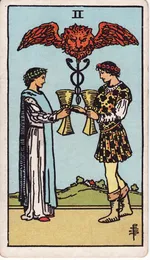 Two of CupsRead as proof the person you like feels the same.
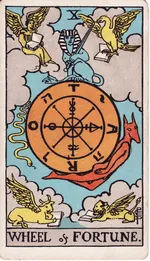 Wheel of FortuneRead as a promise that luck is about to arrive.
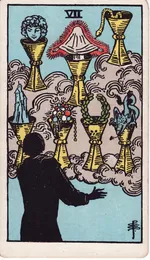 Seven of CupsA row of tempting cups in the clouds. Not all are real; wishful reading treats each as already in your hand.
A sign you may be reading with hope instead of intuition: you feel relief before you have really looked at the cards.
Fear
Fear works the other way. It turns every card into a warning, and even gentle cards seem to hide a catch.
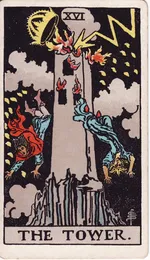 The TowerRead as a disaster.
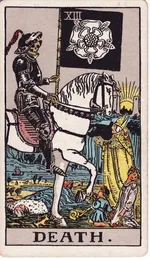 DeathRead as something literal.
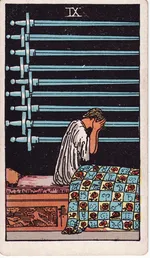 Nine of SwordsAwake in the dark with worries that may not be facts. Fearful reading gives them the authority of a prophecy.
A sign you may be reading with fear: you settle on the worst meaning available, and it feels more like dread than understanding.
Why reading for yourself is harder
Waite passes on a note that many readers still find true: put out of mind “personal bias and preconceived ideas as far as possible, or your judgment will be tinctured thereby.” For this reason, the note adds, “it is more easy to divine correctly for a stranger than for yourself or a friend.”
When you read for yourself, you care about the outcome, and caring bends what you see. This does not mean you should not read for yourself. Hold your first impression a little more loosely, especially on questions that matter a great deal.
A few gentle checks
None of these are rules, and none prove anything. They are ways of noticing what might be shaping a reading.
- Look at the whole spread. Intuition usually fits most of the cards; projection leans on one and ignores the rest. See reading cards together.
- Return to the picture. If your reading of The Moon is pure doom, look again at the path that keeps going between the towers.
- Notice your body. Tension, a racing heart, or quick relief often belong to hope or fear. Intuition tends to feel steadier.
- Let some time pass. A meaning that still feels right the next day is more likely worth keeping than one that fit a single anxious hour.
- Leave room for not knowing. Uncertainty is often more honest than a confident guess.
When both are present
Most readings mix intuition and projection. That is not a failure. Hope and fear tell you something real about what matters to you, even when they are poor guides to what will happen. Noticing “I want this card to mean yes” shows you where your heart is.
The aim is not to remove feeling from a reading. It is to know which feelings point outward at the situation, and which point back at you.
Next guide
The One-Card DrawThe simplest spread: one question, one card, and a few quiet minutes with it.