Spreads
The Five-Card Cross
A small cross of five cards that looks at a situation from its root to what can help.
The Five-Card Cross sits between a three-card spread and the full Celtic Cross: one card at the center, four around it, five questions. Large enough to show a situation from more than one side, small enough to read in a few minutes, it makes a good everyday spread.
What the spread is for
Use it when you have one clear matter in mind and want to understand it better: “What is going on with this project?” or “How can I understand this tension with a friend?” It is less suited to choosing between two options. For that, try the Two Paths spread.
Waite, writing about methods of reading in general, reports what experienced readers hold:
…believe that the way of simplicity is the way of truth.
This spread is built in that spirit: each position has one job, and none of them overlap.
The layout and the positions
The line across runs through time, from left to right. The line up and down runs from what lies underneath to what can help. Tap a place to see its question.
Eight of Swords
What is this situation really about right now?
Bound and blindfolded, with the way out more open than it looks. The stuck feeling may be partly made of thoughts.
Five of Cups
What has led here, or is already fading?
Grief over what spilled, two cups still standing. An earlier disappointment may still be on your mind.
Ace of Wands
What seems to be arriving, or growing?
A fresh spark of energy and desire. Something new wants to start.
The Moon
What lies underneath this, perhaps out of sight?
Uncertainty and half-seen fears. A worry you have not looked at in clear light.
The Magician
What could I lean on, or bring to this?
Skill and focus, with every tool already on the table.
Worked example
- The heart of it: Eight of Swords. Bound and blindfolded, with the way out more open than it looks. The stuck feeling may be partly made of thoughts.
- Behind you: Five of Cups. Grief over what spilled, two cups still standing. An earlier disappointment may still be on your mind.
- Coming in: Ace of Wands. A fresh spark of energy and desire. Something new wants to start.
- The root: The Moon. Uncertainty and half-seen fears. A worry you have not looked at in clear light.
- What can help: The Magician. Skill and focus, with every tool already on the table.
Card 3 shows a direction, not a fixed event; cards 4 and 5 often show what can still shift. Some readers lay a card across the center, as in the Celtic Cross. Here all five stay upright and apart, which is easier to read.
How to read it
Read the center first
Card 1 sets the theme. Everything else is read in relation to it.
Read across
Behind, heart, coming in: a short story through time. Is it moving toward something lighter or heavier, faster or slower?
Read up and down
The root shows what the situation stands on; what can help shows what you can add. Sometimes the help is a direct answer to the root.
Look at the whole, then sum it up
Count the Major Arcana, notice repeated suits or numbers, see where the figures face (more in reading cards together). Then hold the main thread in one or two sentences.
A worked example
Say a creative project has stalled for weeks, and you ask, “What do I need to understand about feeling stuck?” Switch the board to “Worked example” to see the cards.
Putting it together. The story across moves from disappointment (card 2), through a stuck mind (card 1), toward a new spark (card 3). That is a hopeful direction. The vertical line explains the middle: a vague fear at the root is keeping the binding in place, and the help is to remember you already have what you need.
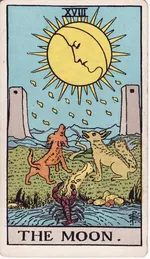 The MoonThe root: not seeing clearly.
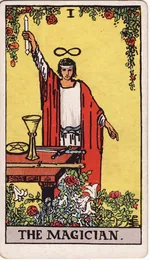 The MagicianWhat can help: using what is right in front of you.
Cards 4 and 5 answer each other, one of the pleasures of the cross shape. One gentle reading: name the fear plainly, then begin one small, focused piece of work with the tools you already have.
Common pitfalls
- Reading the center too heavily. Card 1 is the theme, not the verdict. Moments change.
- Skipping the root. Card 4 can feel puzzling, yet it often makes the others make sense.
- Treating card 3 as fate. It is a tendency. Read it alongside card 5.
- Asking two questions at once. Five cards hold one matter well. Split a two-part question into two readings.
- Forgetting that positions matter. The same card means something a little different at the root than at the center. See positions.
For more room, the Horseshoe adds two cards and a wider arc. For less, a three-card spread is always there.
Next guide
The Relationship SpreadSix cards for reflecting on a bond with someone, with care for both people in it.