Spreads
The Horseshoe Spread
The classic seven-card arc that follows a matter from its past to where it seems to be heading.
The Horseshoe is one of the classic tarot spreads. Seven cards in an open arc follow a matter from the past, down through what is hidden and in the way, and back up toward advice and a likely direction. Larger than three cards and gentler than the Celtic Cross, it is a good next step for many readers.
What the spread is for
Use it when you have one matter in mind and want to see it as a story with a beginning, a middle and a way forward: a change you are going through, a situation that has gone on for some time, a season of life you want to understand. For choosing between two options, see the Two Paths spread.
Name a clear question before you shuffle, and keep it about your own part.
The layout and the positions
Lay the cards left to right in a curve, open at the top, card 4 at the bottom. Some readers flip it into an arch; either works, as long as card 4 sits at the turning point. Tap a place to see its question.
Three of Swords
What has led to this?
Heartbreak and grief. The ending hurt, and that hurt was real.
Four of Swords
What is happening now?
Rest and recovery, a quiet healing pause.
Six of Cups
What is at work that I may not be seeing?
Memory and longing for simpler days. Part of you may still live in the past.
Nine of Wands
What is the main difficulty, or the turning point?
Guarded and braced for the next blow. Protecting yourself may keep new things out.
Six of Pentacles
How are others, or my surroundings, part of this?
Giving and receiving. People are willing to help, if you let them.
Death
What might help?
Let the ending be complete: not a literal death, but the close of one chapter so another can begin.
The Star
If nothing changes, what direction is this taking?
Hope, renewal and quiet healing.
Worked example
- The past: Three of Swords. Heartbreak and grief. The ending hurt, and that hurt was real.
- The present: Four of Swords. Rest and recovery, a quiet healing pause.
- Hidden influences: Six of Cups. Memory and longing for simpler days. Part of you may still live in the past.
- The obstacle: Nine of Wands. Guarded and braced for the next blow. Protecting yourself may keep new things out.
- People around you: Six of Pentacles. Giving and receiving. People are willing to help, if you let them.
- Advice: Death. Let the ending be complete: not a literal death, but the close of one chapter so another can begin.
- Where it is heading: The Star. Hope, renewal and quiet healing.
Card 7 shows a direction, not a fixed ending. Card 6 sits right beside it for a reason: advice is how a direction can change.
How to read it
…to run through the cards quickly, so that the mind may receive a general impression of the subject…
Waite suggests this before reading each card in detail. It suits the Horseshoe especially well, because its shape tells a story at a glance.
Look at the whole arc first
Do the cards get lighter or heavier as they go? Where do the Major Arcana fall?
Read down the left side
How you arrived: past, present, and what works beneath the surface.
Stop at the bottom
Card 4 is the turning point of the arc. Give it the most time.
Read up the right side
The way out: the people around you, what might help, where things seem to lead.
Read across the arc
Pair the cards that face each other: 1 with 7, 2 with 6, 3 with 5. Where you came from and where you are heading, the present and the advice, what is hidden and what others bring.
A worked example
Say you are a few months past the end of a long relationship, and you ask, “How can I approach this next season of my life?” Switch the board to “Worked example” to see the cards.
Putting it together. The left side tells a familiar story: real grief, a needed rest, a pull toward memory. At the bottom, the Nine of Wands: you guard yourself so well it is hard to move. The right side offers a way through: others are ready to help, Death gently asks you to let the old chapter close, and The Star says healing is already underway.
Now read across the arc.
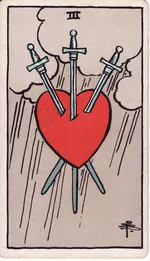 Three of Swords1: the wound…
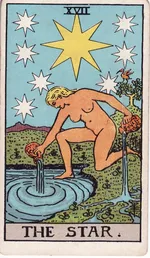 The Star7: …and its healing.
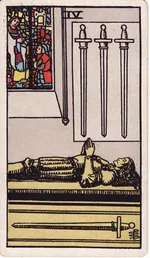 Four of Swords2: rest…
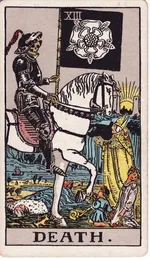 Death6: …and then release.
The Six of Cups and the Six of Pentacles share a number, and both are about giving: one looks back, the other looks around you now.
Common pitfalls
- Rushing to card 7. The direction only makes sense in light of the cards before it, card 6 most of all.
- Fearing a hard card at the bottom. Card 4 is meant to show difficulty. That is the spread doing its job.
- Reading “the people around you” as judgment. Card 5 shows how your surroundings play into the matter, not what anyone privately thinks.
- Taking Death literally. In any position, Death speaks of endings and change, not of physical death.
For how one card changes meaning from place to place, see positions. For reversed cards in a spread like this, see reading reversals.