Start here
How Tarot Works
A deck of pictures that helps you slow down, look closely, and think about your life.
Tarot is a deck of 78 illustrated cards. You shuffle, draw, and look at what is in front of you. That is the whole mechanism. Its use is not a hidden force but the way a picture can open a question you had not quite put into words.
A deck of pictures
Every card shows a scene: a figure, a landscape, a few objects, a mood. Each carries traditional meanings built up over more than a century.
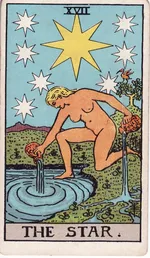 The StarQuiet: a woman pouring water under a night sky.
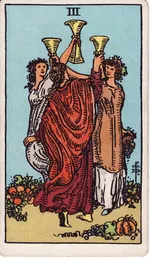 Three of CupsBusy: friends lifting their cups.
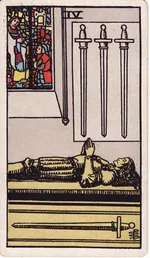 Four of SwordsStill: a figure resting on a tomb.
A. E. Waite, who designed the deck most people learn with, put it this way:
The Tarot embodies symbolical presentations of universal ideas.
In plainer words, the cards show situations almost everyone meets: starting over, waiting, losing, celebrating, choosing. Because the ideas are shared, a card can speak to your situation without knowing it. For how the deck is organized, see The 78 Cards.
Why a random card can still be useful
Chance decides which picture you get; your mind decides what to do with it. Holding the card against your situation, asking where it fits and where it does not: that small act of comparing is where the value lies.
A card works like a good question from a friend. It does not hand you an answer; it points at something, and you notice what you think. Draw the Four of Swords and you might realize how tired you are. A quick “no, not now” tells you something too.
So a card can mean slightly different things to different people, or on different days. The tradition gives the range; your life decides where in it the card lands.
What a reading looks like
A reading needs no ceremony. Most follow the same simple steps.
Ask, shuffle, draw
Ask an open question: “What do I need to see about this job?” rather than “Will I get this job?” Shuffle until it feels done. Take one card, or lay out a spread, where each place has a job, such as “the situation” or “what helps.”
Look before you look it up
Notice each picture first: who is there, what they are doing, how it makes you feel. Then read the traditional meaning and see what fits.
Put it together
Ask what the card, or the cards together, suggest about your question.
For a first practice, start with One Card. When you want more, Three-Card Spreads is the next step.
A short example
Worked example
Should I take on a new project?
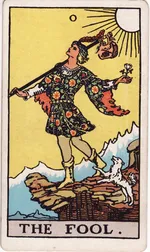 The Fool
The feeling: light, a bit reckless, hopeful. The meaning: a beginning, trust, a step into the unknown, and the risk of not watching your feet. Your curiosity may be worth following, with a basic plan.
Or you might be the dog, barking a warning. Both are honest readings. The card has done its job if you see your own position more clearly.
Upright and reversed
Cards can come out of the shuffle upside down. Many readers treat this as a shift in meaning; others read every card upright. Both approaches are fine.
Upright
The card’s energy as it is drawn.
Reversed
The same energy, but blocked, turned inward, or taken too far.
You can read more in Reading Reversals.
What tarot can and cannot do
Tarot is a tool for reflection. It can help you name a feeling, notice a pattern, or see a situation from another side. It is good at questions about you: your choices, hopes and habits.
It is not a way to know the future. A “hard” card is not a sentence passed on you: every card describes a moment, and moments change.
Where to go from here
You do not need to memorize 78 meanings first. Learn the structure, draw a card a day, and let the meanings grow through use. A good path:
- The 78 Cards for how the deck fits together
- The Fool’s Journey for the story of the Major Arcana
- Suits and Elements for the four suits
- Intuition and Projection for telling what the card says apart from what you hope it says
Go slowly. The cards will still be there tomorrow.
Next guide
The 78 CardsHow the deck is built, from the 22 Major Arcana to the four suits of the Minor Arcana.